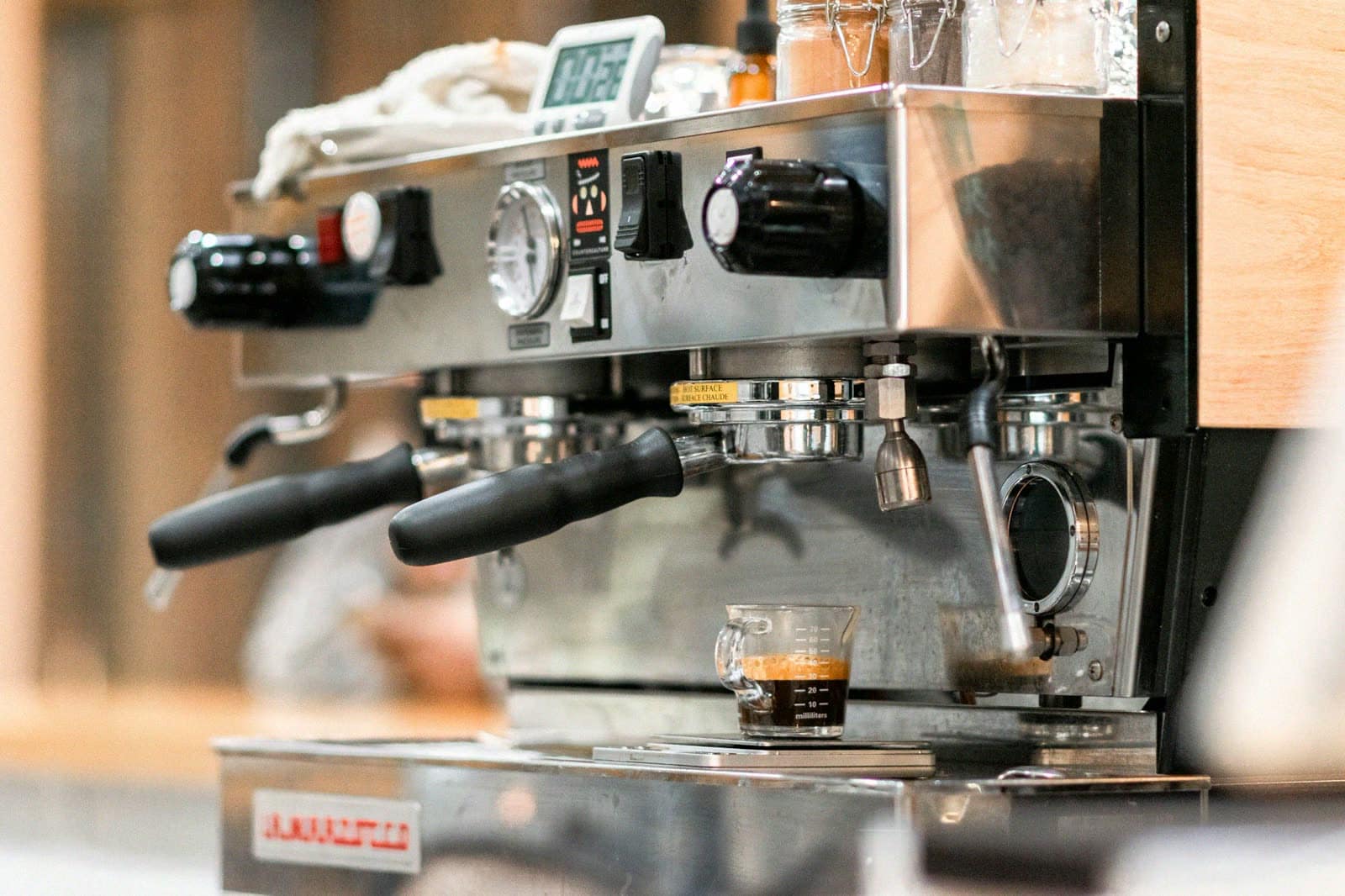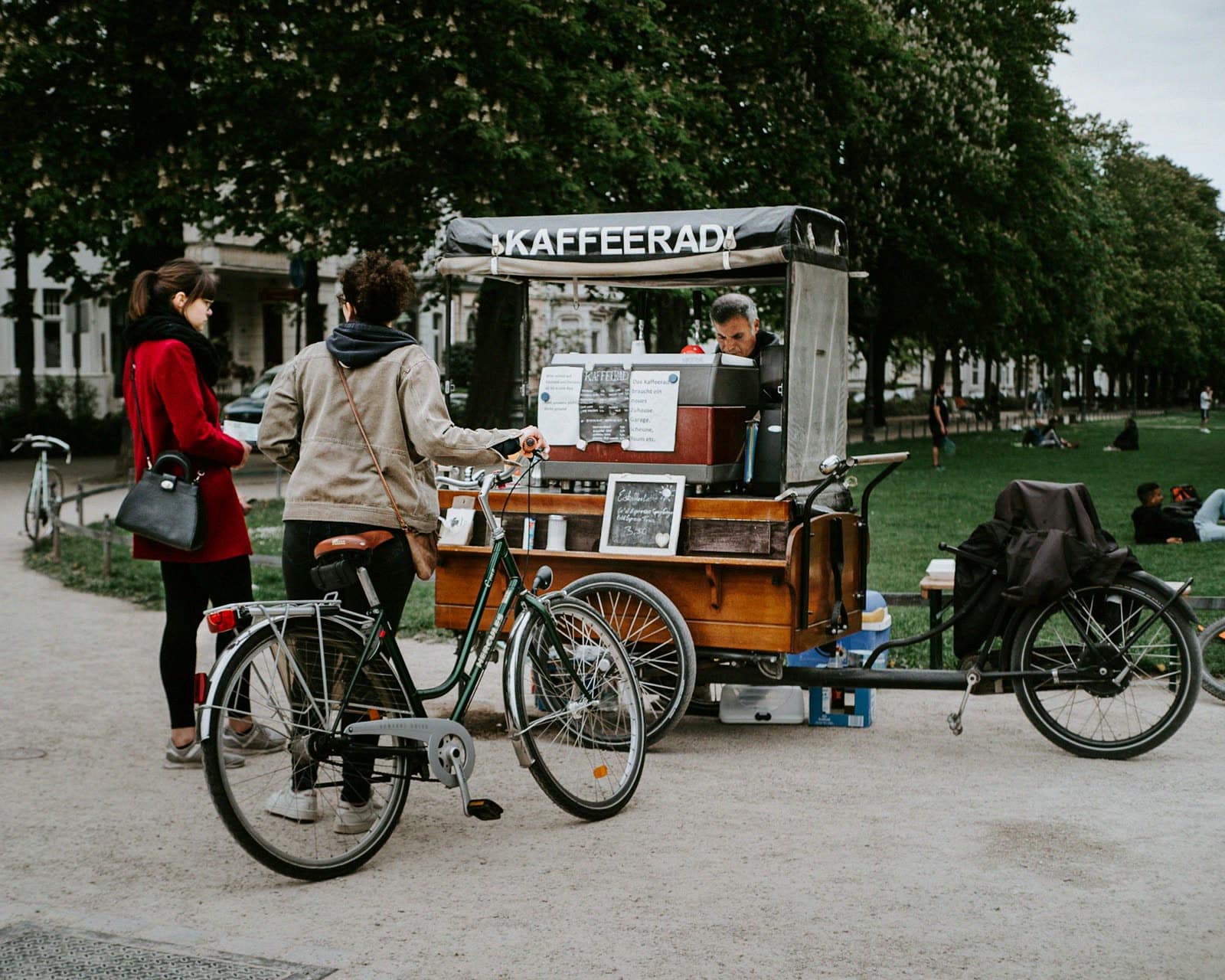
Give the espresso machine its own circuit. For most single-group machines that means a dedicated 120V/20A outlet. For most commercial two-group machines it means 240V. Put the grinder, fridge, and lights on a second circuit.
That alone heads off most tripped breakers. For anything below, go by your machine's nameplate and local code, and ask a licensed electrician when in doubt.
Start with the machine
An espresso machine is a heating element attached to a boiler, and the element is the load that matters. The grinder runs for seconds at a time and the fridge cycles. The element runs hard through heat-up, then fires every time you pull a shot or steam milk. During a rush that is nearly constant.
Read the nameplate
Find the rating plate, usually on the back, the underside, or near the drip tray. Write down:
- Volts (V). 120V or 220-240V. This decides which outlet the machine needs.
- Watts (W). What it draws at full load.
- Amps (A), if they're listed. Some plates leave them off, and you can work them out from the other two.
Use watts = volts x amps. A 1,500W machine on 120V pulls 1,500 / 120 = 12.5A. A 3,600W machine on 240V pulls 3,600 / 240 = 15A. Do this for every device on the cart and keep the list with your gear.
Know the three circuits
- 120V / 15A. The standard household outlet, NEMA 5-15. 1,800W on paper.
- 120V / 20A. NEMA 5-20. One slot is shaped like a sideways T. 2,400W on paper.
- 240V. A dedicated circuit with a locking or large-blade outlet, such as NEMA L6-30 (30A locking) or 6-50 (50A).
Don't plan on the paper number. Safe practice keeps a long-running load at or below 80% of the breaker rating:
- 15A: 12A, about 1,440W at 120V.
- 20A: 16A, about 1,920W at 120V.
- 30A at 240V: 24A, about 5,760W.
The machine cycles rather than running flat out, but plan as if it doesn't. Breakers that sit near their limit through a three-hour service are the ones that trip.
Match the machine to the outlet
Wattages vary, so go by your own plate. The rough pattern looks like this.
- Single-group and prosumer machines are commonly 120V and often fall around 1,200W to 1,800W. Some use a standard 5-15 plug. Some ship with a 5-20 plug that only fits a 20A outlet.
- Commercial two-group machines are commonly 240V and often draw 3,000W or more. Some can be set up for 120V, usually with a smaller element and slower recovery.
A machine near 1,500W already sits above the 1,440W planning figure for a 15A circuit. It might get through a slow Tuesday morning, but expect it to trip at a busy wedding.
Add up the rest of the cart
- Grinder. Short bursts, with a spike at startup.
- Undercounter fridge. It runs on very little, but the compressor surges each time it kicks on.
- Lights and phone chargers barely register.
- Blender. A commercial blender can draw well over 1,000W. Give it its own circuit or keep it away from heavy steaming.
- Hot water tower or second boiler. Another heating element. Count it like the machine.
Worked example
A 120V single-group machine rated 1,500W, a 400W grinder, a fridge at 150W running, and 50W of lights:
- Machine: 1,500W / 120V = 12.5A
- Grinder: 400W / 120V = 3.3A
- Fridge: 150W / 120V = 1.25A
- Lights: 50W / 120V = 0.4A
- Total: about 2,100W, or 17.5A
That's over the planning figure for both a 15A and a 20A circuit, so split it across two.
- Circuit 1, 20A preferred: machine alone, 12.5A.
- Circuit 2, 15A is fine: grinder, fridge, lights, about 5A.
With the load split, your request to the venue fits in one line: "Two separate circuits within 50 feet of the cart, one of them 20A."
Get the venue's answers in writing
"Is there power?" gets you a yes and one outlet behind the DJ booth, shared with the uplighting. Ask for these instead.
- Voltage and amps. 120V 15A, 120V 20A, or 240V.
- A photo of the outlet. A 5-15, 5-20, L6-30, and 6-50 look different. A 5-20 plug will not go into a 5-15 outlet, and the photo catches that before the drive.
- What else is on the circuit. Outlets on the same wall often share a breaker. So do the DJ, the lighting, and the caterer's warmers.
- How many feet it is from your setup spot to the outlet.
- Indoor or outdoor. Outdoor outlets are usually GFCI-protected and can trip when wet, say after the sprinklers run. Ask if they are covered.
- A name and phone number for someone on site who knows where the panel is.
Use the right cord
A long, thin cord drops voltage at the machine. The element heats slower and the steam goes weak right when the line is longest.
- 12 AWG for a 20A run. 14 AWG is a 15A cord. Never put the machine on a 16 AWG household cord.
- Use the shortest cord that reaches. For long runs, step up to 10 AWG.
- Outdoor-rated, with an amp rating at or above the circuit. One cord per circuit, no daisy chains or household power strips.
- Touch the plug mid-service. If it's warm, the cord is undersized or damaged and needs replacing.
Size the generator
- Start by adding up running watts. The example cart comes to about 2,100W.
- Cover starting watts. Motors surge on startup, heating elements barely do. The starting rating has to cover your largest motor kicking on while everything else runs. A 2,500W generator on that 2,100W cart can stall the moment the fridge compressor starts mid-rush.
- Add headroom. Size the running rating roughly 25% to 50% above your load. For the example, around 3,000W to 3,500W running.
- Match the voltage. Many small portable generators are 120V only. A 240V machine needs a 240V outlet, often an L14-30. Check before you buy.
Go with an inverter generator. The power is steadier, which is easier on machine controllers and card readers, and it's far quieter. Ask the venue first, since many restrict generators or want them parked away from guests. Carry fuel for the full day, stored per local fire rules.
Be honest about batteries
A 2,000Wh battery station feeding a steady 1,500W load lasts a little over an hour, less after inverter losses, and heat-up alone takes a big share. Use a battery for lights, a grinder, a card reader, or a short pop-up with a small machine. For a multi-hour espresso service, plan on a circuit or a generator. Check a station's continuous output in watts as well as its Wh.
Before you leave for the event
- Watts and amps listed for every device, with the machine on its own circuit.
- The venue's written answers and outlet photo in hand.
- Cords of the right gauge and length, plus any adapter the outlet needs.
- Generator fueled and tested, or battery charged, if there is no venue power.
- A plan to switch the machine on early, before the caterer's warmers load the circuit, so heat-up is done before guests arrive.
- A licensed electrician consulted on any outlet, adapter, or hookup you are unsure of.
Keep the answers somewhere you can pull them up at the venue. In VenVen, you can store the venue and your power notes on the event itself, alongside its quote. For the rest of the build, see the startup cost breakdown and the guide to starting a coffee cart.
Field Notes is a VenVen column. Setup, permits and gear, from the parking lot up.